Working with the Rotterdam Design System
For the course Maatschappij & Interactie, I researched the behavior patterns of users of the Jumbo App. Together with my project partner, I analyzed the behaviors users display when ordering groceries.
To draw our conclusions, we utilized various methods, such as Fogg’s B=MAP model, Cialdini’s principles, and Harris’s 10 Hijacks.
Based on our findings, we developed a concept aimed at encouraging more people to pick up their ordered groceries in-store.
Working with the Rotterdam Design System
For the course Maatschappij & Interactie, I researched the behavior patterns of users of the Jumbo App. Together with my project partner, I analyzed the behaviors users display when ordering groceries.
To draw our conclusions, we utilized various methods, such as Fogg’s B=MAP model, Cialdini’s principles, and Harris’s 10 Hijacks.
Based on our findings, we developed a concept aimed at encouraging more people to pick up their ordered groceries in-store.
Working with the
Rotterdam Design System
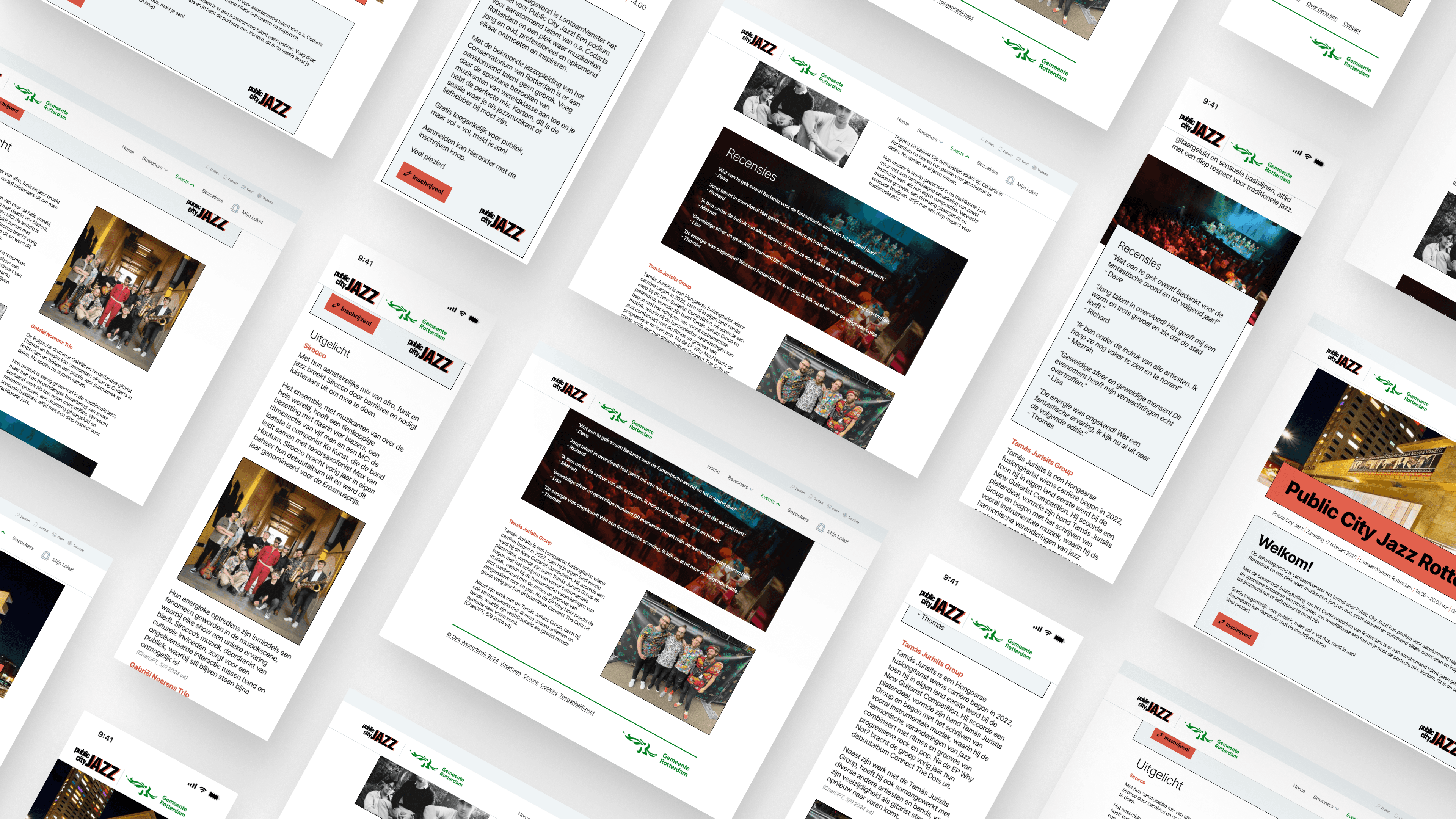
Public City Jazz was the final assignment we received that focused purely on design. For this project, we worked with the design system of Rotterdam, where small adjustments to the brand identity were allowed.
Through this project, I discovered that working with and designing brand identities is something I find highly satisfying. On the other hand, I realized that animation is something I’m less passionate about.
During this project, I had to pay close attention to the many subtle nuances that define the Rotterdam’s brand identity. I followed these guidelines down to the millimeter. Every element in the prototype was "handcrafted" by me and assembled into a page that could be published onto Rotterdam’s official website.
In addition, I had to consider the atmosphere I wanted to create for Public City Jazz. Jazz has a certain classy feel but also tends to draw outside of the lines (🇳🇱buiten de lijnen tekenen). I believe I managed to capture that essence in this design—sometimes quite literally, by adding a thin border to an element.
The Logo
When receiving the design case, I noticed that Public City Jazz didn’t have a logo. It was up to us that Public City Jazz would get one.
For the logo design, I took inspiration from Rotterdam’s brand identity and the feeling I associate with jazz. Jazz isn’t a "polished" form of music, but since the event is organized by Rotterdam, I felt the design needed a more structured approach to align with Rotterdam’s sleek and modern branding.
Concluding
Looking back on the Public City Jazz assignment, aside from the animation challenge, it is one of the projects from the past two years that I am very satisfied with. There are definitely areas for improvement in the future, but I believe this is a strong starting point.
This project has further stimulated my interest in working with brand identities, similar to how the Jumbo case also sparked some curiosity. Designing a brand identity seems intriguing to me, and I would love to focus more on it in the future.